
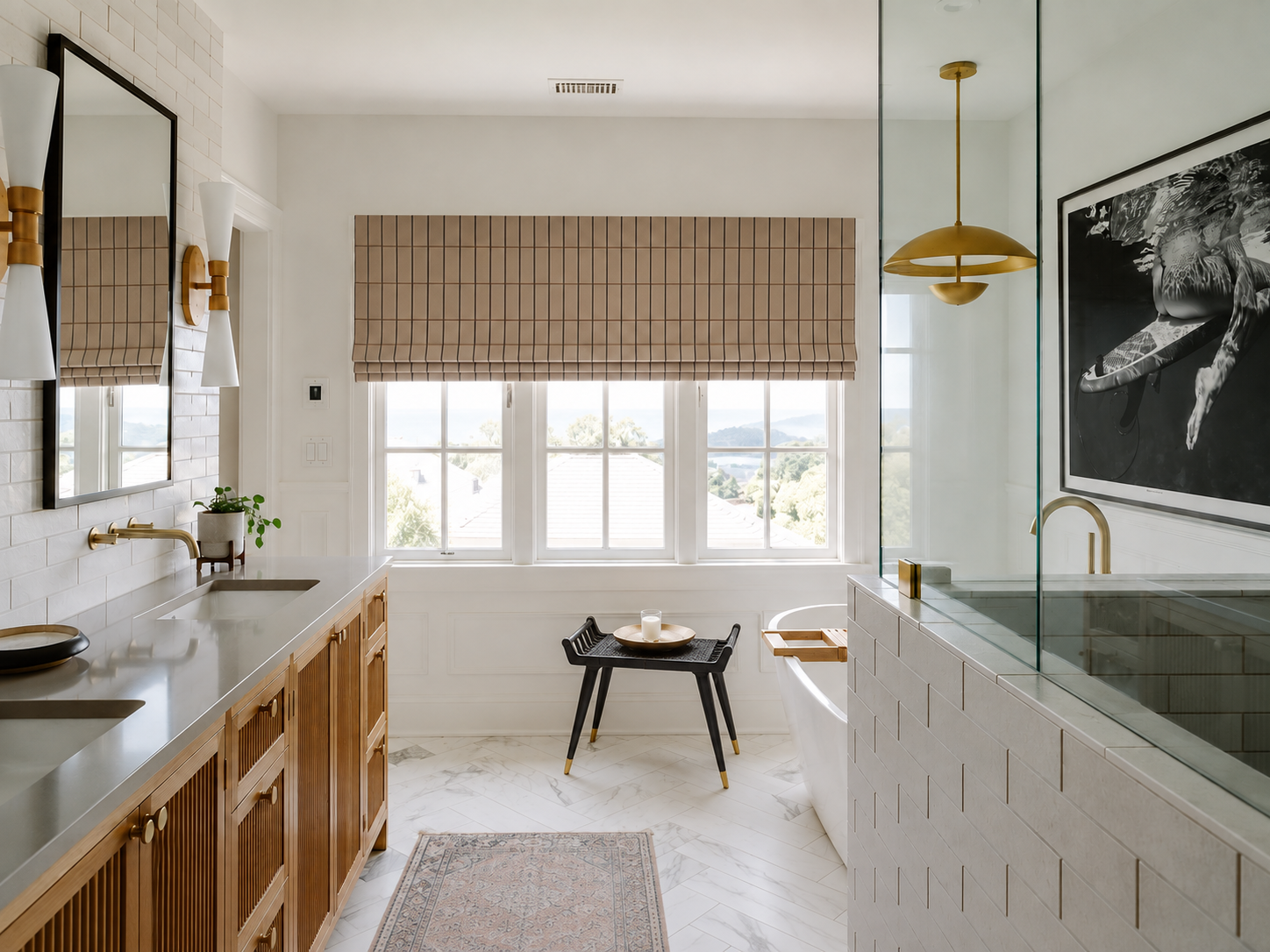
Most bathrooms are designed with one lighting question in mind:
Is there enough light?
I think we should be asking another question too:
What time of day are you using it?
The bathroom is one of the first rooms many of us walk into in the morning and one of the last rooms we use before going to bed.
Yet we often give it one lighting plan.
One switch goes on and suddenly every recessed light, vanity light and overhead fixture is illuminating the room at full brightness.
That might make sense at 7:00 in the morning when you're trying to wake up, get ready and put on makeup.
It feels very different at 10:30 at night when you're brushing your teeth before bed.
As an interior designer, I prefer to approach bathroom lighting as two very simple experiences: one for waking up and one for winding down.
You don't need an elaborate smart-home system to accomplish it.
Sometimes it really is as straightforward as one switch for one layer of lighting and another switch for the other.
Can Bathroom Lighting Really Affect Your Circadian Rhythm?
Yes, although I want to be careful about what that means.
Your bathroom lighting alone is not going to control your entire circadian rhythm.
But light is one of the body's strongest environmental signals for distinguishing day from night.
Research on human circadian biology consistently shows that light exposure helps synchronize our internal clock to the approximately 24-hour day. Morning light generally encourages an earlier circadian phase, while evening and nighttime light can shift that timing later. Higher evening light exposure can also interfere with melatonin and is associated with taking longer to fall asleep.
Recent public-health guidance based on light research describes the basic principle very simply: brighter light during the morning and daytime, less light in the evening, and darkness or near-darkness while sleeping.
That doesn't mean your bathroom needs to become a laboratory.
It means the lighting can work with what your body is already trying to do rather than treating 6:30 a.m. and 11:30 p.m. exactly the same.
Why I Like Two Bathroom Lighting Plans
In practice, my approach is simple.
I want a bathroom to have a brighter functional layer for the morning and a softer, warmer layer for nighttime.
Those two layers should operate separately.
One switch might control the recessed lighting or another brighter source you use while getting ready.
Another controls your warmer vanity lighting.
Add dimmers, and suddenly the same bathroom can behave very differently depending on the time of day.
This is one of those design decisions that sounds small on a set of plans but can completely change how a room feels to use.
Morning Bathroom Lighting Should Help You Wake Up
Your morning lighting has several jobs.
You need to be able to see.
You may be getting dressed.
You may be shaving or doing your hair.
You may be applying makeup.
And, physiologically, morning is the time when brighter light is generally more compatible with the body's natural wake cycle.
Research has found that appropriately timed morning light can advance circadian timing, and bright morning light is used clinically in certain circadian sleep interventions.
I am not suggesting that your bathroom fixture is a replacement for natural daylight or prescribed light therapy.
It isn't.
But from a design perspective, the principle makes sense: the morning is the time when I am much more comfortable giving you useful, brighter light.
If the bathroom has great natural morning light, even better.
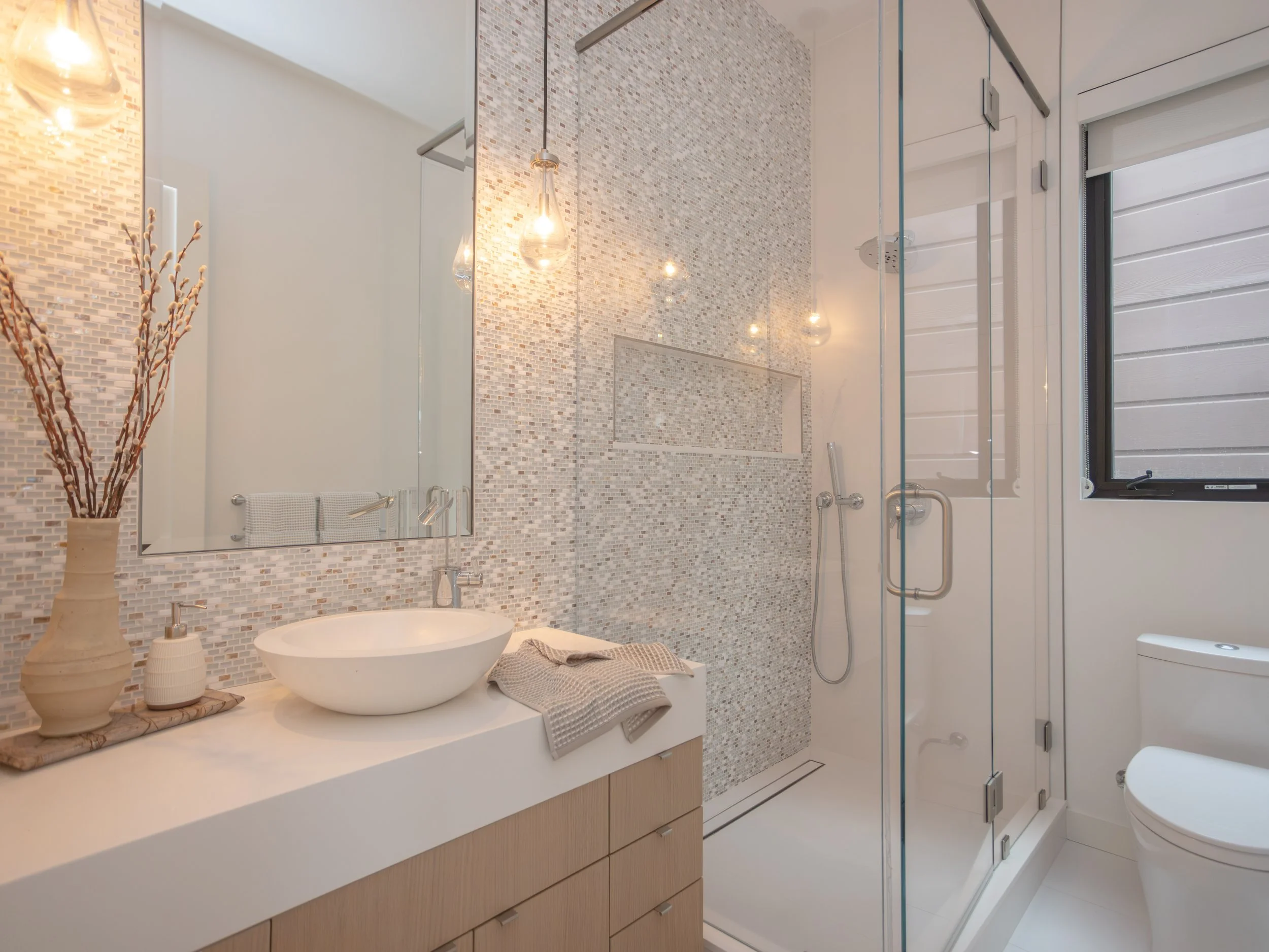
Good Makeup Lighting Is About Direction, Not Just Brightness
This is also where the placement of the light becomes really important.
One of my biggest priorities at a bathroom vanity is getting light toward your face rather than only from above your head.
Overhead lighting can create shadows under your eyes, nose and chin.
For makeup, grooming and shaving, I generally prefer light positioned on both sides of the mirror so your face is illuminated more evenly.
The Illuminating Engineering Society similarly notes the importance of sufficient illumination at bathroom mirrors and points to sconces, pendants and certain illuminated mirrors as effective approaches.
That doesn't necessarily mean recessed lighting is bad.
It's just doing a different job.
The mistake is expecting one bright ceiling fixture to do every job in the bathroom.
Lighting has direction.
It has diffusion.
It has intensity.
It has color.
Where the light comes from can be just as important as how bright it is.
At Night, I Want the Bathroom to Feel Completely Different
Now imagine the same bathroom at night.
You're getting ready for bed.
Maybe you're washing your face, brushing your teeth and taking a shower.
Your body does not need the same visual experience it needed while getting ready for work in the morning.
I want the bathroom to become softer.
This is when I prefer warmer vanity lighting at a lower level rather than automatically turning on bright overhead lighting.
The goal isn't darkness.
The goal is enough light to safely and comfortably use the bathroom without making the room feel aggressively awake.
That idea has support in lighting research.
Experts studying circadian lighting generally recommend lowering evening light exposure, with intensity being one of the most important variables. The Illuminating Engineering Society has also discussed using warmer color temperatures and limiting overhead light at night as strategies for creating a clearer biological difference between day and night.
Research also shows that evening light can suppress melatonin and shift circadian timing, although the effect depends on the intensity, spectrum, timing and duration of the exposure as well as individual sensitivity.
That is why I wouldn't reduce this conversation to simply saying, “Blue light is bad.”
The real picture is much more nuanced.
Dimmers Are One of the Simplest Improvements You Can Make
I love dimmers in a bathroom.
Especially at night.
Maybe you're getting ready for bed at 9:00 and you want a little more light.
At 2:00 in the morning, you may want almost none.
Being able to control the amount of light means the room can respond to what you're doing instead of forcing you to choose between completely dark and completely illuminated.
This becomes especially important with nighttime bathroom trips.
Turning on a row of bright recessed fixtures in the middle of the night is a very different experience from bringing a warm vanity light up just enough to see.
It's a small luxury that you notice every single day.
Warm Light and Dim Light Are Not the Same Thing
This is an important distinction.
Homeowners sometimes use the words warm, dim and soft interchangeably, but they describe different qualities of light.
Brightness is about how much light there is.
Color temperature describes whether the light appears warmer and more amber or cooler and more blue-white.
Direction describes where that light is coming from.
And then there is diffusion, or how soft versus direct the source feels.
For nighttime lighting, I am thinking about all of them.
I may want:
Less light overall
A warmer color temperature
Light directed toward the vanity rather than flooding the ceiling
A diffused source that doesn't feel harsh
The best result usually comes from layering these decisions together rather than chasing one magic bulb specification.
The Biggest Bathroom Lighting Mistake I See
One switch.
Everything comes on.
Every time.
It is incredibly common.
And it means the bathroom has exactly one mood: fully on.
I would much rather separate the lighting layers.
The recessed lights do not have to come on simply because the vanity lights are on.
The vanity lighting does not have to operate at full intensity.
A decorative fixture can have its own control.
This isn't about making the electrical plan complicated.
It's about giving yourself choices.
Two well-planned switches can often be more useful than ten fixtures controlled together.

Your Bathroom Is Part of Your Evening Routine
I think bathrooms are sometimes designed as isolated functional spaces.
But think about what actually happens there at night.
It is often part of a sequence.
You leave the brighter parts of the house.
You wash your face.
Maybe you take a shower.
You brush your teeth.
You put on pajamas.
Then you walk into your bedroom and go to sleep.
I want the environment to support that transition.
I don't want the bathroom to interrupt it by suddenly becoming the brightest room you've experienced all evening.
This is where I think design can support what people sometimes loosely call the nervous system.
I wouldn't say that a warm bathroom sconce magically regulates your nervous system.
What I would say is that our environment can either support a transition toward rest or work against it.
Lighting is part of that environment.
And research gives us good reason to reduce bright evening and nighttime light when we are trying to preserve a clear day-night pattern.
Bathroom Lighting Should Change With How You Use the Room
This principle extends beyond bathrooms.
One of the things I think about constantly as a designer is that a room does not have one job for 24 hours a day.
Your kitchen feels different during breakfast than it does during a dinner party.
A living room needs different lighting for entertaining than it does for watching a movie.
A bedroom shouldn't necessarily look at 10:00 p.m. the way it does at 10:00 a.m.
The bathroom is one of the easiest places to apply that idea because the two use cases are so distinct.
Morning:
Brighter. Functional. Energizing. Good visibility.
Night:
Warmer. Softer. Dimmer. Calm.
The lighting changes because you change throughout the day.
You Don't Need to Overcomplicate This
Circadian lighting can become incredibly technical.
Researchers look at the amount of light reaching the eye, wavelength, duration of exposure, timing, individual sensitivity and metrics that go far beyond the typical residential lighting plan.
That's important science.
But I don't think a homeowner needs to calculate all of that to make better lighting decisions.
The practical takeaway is surprisingly simple:
Give yourself more useful light during the day and the ability to dramatically reduce it at night.
Let daylight do as much work as possible.
Separate your lighting layers.
Put your vanity lighting where it actually illuminates your face.
Use dimmers.
And don't make bright overhead lighting your only option at 11:00 at night.
Good Lighting Isn't Just About Seeing the Bathroom
It's about how the bathroom feels to use.
I want enough light in the morning that you can get ready comfortably and actually see yourself.
And at night, I want you to be able to walk in, turn on one switch and have the room immediately feel softer.
That is good lighting design to me.
The science around circadian rhythms adds another reason to think about it, but even without the research, the experience is noticeable.
Our homes should respond to how we live throughout the day.
Sometimes creating that experience doesn't require something wildly complicated.
Sometimes it is simply:
One switch for morning.
One switch for night.
And a dimmer so you get to decide how much light you need.
If you're planning a bathroom remodel or new build in the South Bay, lighting is something I prefer to resolve while we are still designing the room, not after the electrical has already been installed.
Because where the lights go, where the switches go and which fixtures operate together are all part of the design.
FAQs
What bathroom lighting is best at night?
At night, lower light levels are generally preferable to a brightly illuminated bathroom. A separate warmer, dimmable lighting layer can provide enough visibility for getting ready for bed without relying on full-strength overhead lighting.
Can bathroom lighting affect your circadian rhythm?
Light exposure contributes to the signals that regulate the body's circadian clock. Morning light generally encourages earlier circadian timing, while bright evening and nighttime light can delay circadian timing and suppress melatonin. Bathroom lighting is only one part of a person's total daily light exposure.
What is the best lighting for applying makeup in a bathroom?
Light directed toward the face is generally more useful than relying exclusively on overhead light. Placing vanity lights or sconces on both sides of the mirror can provide more even facial illumination and reduce shadows.
Should bathroom lights be on separate switches?
Separate switches allow different lighting layers to be used independently. For example, brighter recessed or general lighting can be used in the morning while warmer vanity lighting can be used by itself at night.
Are dimmers worth installing in a bathroom?
Yes. Dimmers allow you to adjust light levels throughout the day and can be especially useful during nighttime bathroom visits when full-strength lighting may feel unnecessarily harsh.
