

My Italian grandmother had a room no one went into.
You probably know the kind.
Everything was perfectly arranged. Nothing moved. It was technically a living room, except no one actually lived in it.
And in another room, the sofa was wrapped in plastic.
As a kid, I could never understand it.
Then at my own house, my mom wouldn't let us hang things on the walls.
So maybe it is no surprise that I grew up wanting to design homes that were almost the exact opposite.
I love beautiful things. I love a finished room. I love the feeling of walking into a house where every material, piece of furniture and detail has been considered.
But I don't believe you should be afraid of your home.
Your children should be able to be children in it. Your guests should be able to put a drink down without feeling nervous. You should be able to sit on the sofa, cook in the kitchen and have people over without mentally calculating what might get stained, scratched or broken.
To me, a beautiful home that you are afraid to live in is not luxury.
The real luxury is having a home that is beautiful and works beautifully for your life.
What Does Livable Luxury Mean in Interior Design?
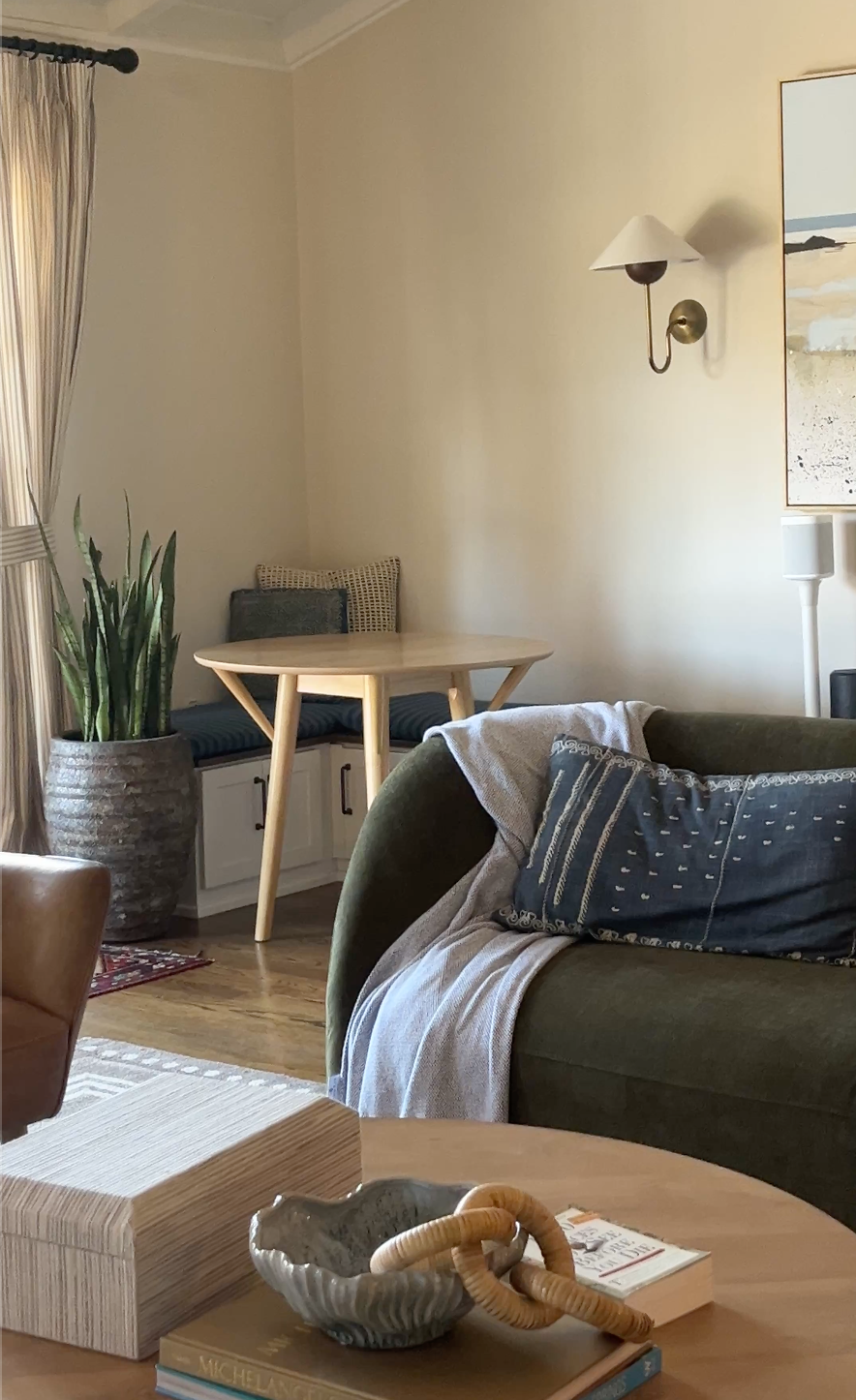
Livable luxury means creating a home that feels thoughtfully designed and special without making everyday life feel like a threat to it.
That doesn't mean everything has to be indestructible.
It means making intentional decisions about where durability matters, how the home will actually be used and which materials are appropriate for the people living there.
Sometimes that means performance fabric.
Sometimes it means more storage.
Sometimes it means choosing a different stone for the kitchen island.
And sometimes it means dedicating part of a beautifully designed home to a giant collection of children's artwork.
Livability isn't one material or one design style.
It starts with understanding the people who live in the house.
A Beautiful Home Has to Work on a Tuesday
It is fairly easy to make a house look good for a photograph.
Real life is more complicated.
There are backpacks.
Mail.
Shoes.
Dog leashes.
Groceries.
Water bottles.
Chargers.
Children's artwork.
Coffee makers.
The eight things someone insists need to live on the kitchen counter.
People come home carrying things, drop things, spill things and accumulate things.
That doesn't mean the house has to look chaotic.
It means I need to understand all of those things before I design it.
One of the questions I think about is very simple:
What is this person walking through the door with?
Where do the keys go?
Where does the purse go?
Where do the kids put their backpacks?
Where are the shoes?
If we don't give those things a place in the design, they don't disappear because the house is beautiful.
They end up on the kitchen island.
Good interior design doesn't pretend real life isn't going to happen.
It plans for it.
Storage Is Part of the Design, Not Something We Figure Out Later
Storage is one of the biggest components of creating a livable home.
When I am designing a kitchen, for example, I don't only care about the cabinet color and the countertop.
I want to know what you need to store.
How do you cook?
What appliances stay out?
Which appliances do you want hidden?
Do you buy in bulk?
Are there things you use every morning?
Do your kids need access to their own snacks and cups?
Beautiful cabinetry isn't particularly useful if we haven't planned what is supposed to go inside it.
The same thinking applies throughout the house.
A beautiful entry should have somewhere for the things you actually bring through the entry.
A family room should account for what your family does in the family room.
A bathroom should have somewhere to put the products you actually use.
When storage is planned from the beginning, the house can stay beautiful because it works.
Kids Don't Have to Disappear From the Design
One of my clients had young children who were constantly bringing home artwork.
That was their life at that stage.
We could have designed a pristine room and then told the family to figure out where all of the paintings, drawings and school projects should go.
Instead, we made them part of the design.
We incorporated an aesthetically designed corkboard where the children's artwork could be displayed.
And the best part is that the display changes.
That wall isn't static. It grows with the kids.
To me, that makes the house more interesting, not less beautiful.
Sometimes with younger children, the answer is also creating an area specifically for them.
Giving kids a place where they can play, build, draw and make a mess can actually help the rest of the home function better.
It isn't about hiding children from an adult house.
It's about acknowledging that children live there too.
Their needs deserve to be part of the floor plan.
I Don't Want You Nervous Every Time Someone Sits Down
Furniture is another place where beauty can get in the way of actually living.
I don't want to specify a sofa that looks incredible but no one finds comfortable.
And I don't want you hovering every time someone sits on an upholstered chair because you're worried about the fabric.
This is where material selection matters.
For busy households, I often consider performance fabrics and more stain-resistant upholstery. A beautiful rug may need to be selected differently in a family room than it would be in a formal adult sitting room.
You don't have to eliminate light fabrics or expensive furniture.
You just need to understand what you're buying and where you're putting it.
There is a big difference between intentionally selecting something delicate because you love it and accidentally selecting something completely incompatible with your life.
My job is to help a client understand that difference.
Sometimes the Most Beautiful Material Isn't the Right Material
This comes up constantly during remodels.
A client may fall in love with a particular stone, floor or fabric. It may be gorgeous.
That doesn't automatically make it right for their house.
I had clients with young children who were considering marble for their kitchen island.
Marble is beautiful, but I knew that particular family wanted a kitchen they could really use without constantly worrying about the surface.
We redirected the selection toward quartzite so they could still have a beautiful natural stone while choosing something that better aligned with how they wanted to live.
That decision is a good example of how I think about materials.
I am never asking only:
Which one is prettier?
I am also asking:
Which one is right for these people?
There may be another client who loves the way marble ages and is completely comfortable with etching and patina. For that person, marble may still be the right answer.
Livable design isn't about declaring certain materials good and others bad.
It is about making an informed choice.

Too Much White Can Make a House Harder to Live In
I love light interiors when they make sense.
But there is a point where making everything white can start working against the people living there.
White sofa.
White rug.
White dining chairs.
White walls.
Very light stone.
And then a family with three kids and a dog is supposed to relax in it.
That doesn't mean families can't have light-colored homes.
They absolutely can.
But there are ways to layer color, texture and variation so that the home doesn't require constant vigilance.
Sometimes a mid-tone fabric will serve the room better.
Sometimes pattern is your friend.
Sometimes natural variation in a material makes everyday wear less noticeable.
And sometimes the answer is simply choosing a performance version of the material you already love.
The goal isn't to design around the assumption that something will be destroyed.
It's to make the house forgiving enough that everyone can relax.
Comfort Is Part of Luxury
This sounds incredibly obvious, but furniture should be comfortable.
I see spaces where everything has been selected for appearance and almost nothing makes you want to sit down.
That is a problem.
If the beautiful chair in the corner is miserable to sit in, it isn't performing its most basic job.
The same applies to furniture layouts.
A living room may look perfectly symmetrical on paper, but if the chairs are too far apart for a conversation, the design isn't working.
A dining chair may photograph beautifully, but if your family has two-hour dinners together, comfort matters.
The way a home feels to use is part of its beauty.
Design Around What Matters to You
One of the biggest mistakes homeowners can make is designing around an idea of how they think a beautiful house is supposed to look instead of around their actual life.
I would much rather know that you host a huge Sunday dinner every week than simply hear that you want a beautiful dining room.
That information changes the design.
If you love cooking with your children, tell me.
If your family piles onto one giant sofa every night, tell me.
If you never use a formal dining room but work from home every day, that matters.
If you collect wine, books, records or art, that matters.
The best design decisions often come from information that initially doesn't sound like interior design at all.
Because I am not really designing for an imaginary person who lives perfectly.
I am designing for you.
Your Guests Should Be Able to Relax Too
One of my favorite tests of livable luxury is how guests feel in a home.
A luxury home shouldn't make someone afraid to touch anything.
I want people to walk in and think the house is beautiful.
And then I want them to sit down.
Put their drink on the table.
Stay for dinner.
Take their shoes off.
Get comfortable.
There is something wonderful about a house that feels special without feeling intimidating.
I don't think those ideas are opposites.
In fact, I think that feeling of ease is one of the hardest things to design well.
A Livable Home Can Still Be Beautiful
There is sometimes an assumption that making practical decisions means compromising the design.
I don't see it that way.
The goal isn't to put the indestructible option everywhere.
It's to find the beautiful option that is appropriate for the application.
An attractive storage solution instead of clutter.
A performance textile that still has the texture and hand I want.
A natural stone that works for the client's tolerance for maintenance.
A dedicated kids' area that integrates with the architecture instead of looking like an afterthought.
A corkboard that becomes part of the design.
Practicality can actually lead to some of the most personal decisions in a house.
And personal homes tend to be much more interesting than perfect ones.
The House Should Change With You
This is another reason I love that children's artwork example.
A good home doesn't have to remain frozen in the exact condition it was in on installation day.
Life changes.
Children grow.
Collections grow.
People entertain differently.
Furniture moves.
You bring things home from trips.
Something gets inherited.
Something gets scratched.
A house develops a history.
I don't think good interior design should fight that.
It should create a strong enough foundation that the house can absorb those changes and still feel like itself.
Maybe that belief goes all the way back to my grandmother's untouched room.
I remember thinking: What is the point of having a beautiful room if nobody gets to enjoy it?
I still think that.
To Me, This Is What Luxury Looks Like
Luxury is being able to invite everyone over and not spend the evening worrying about your furniture.
Luxury is a kitchen designed around how you actually cook.
It is storage where you need it.
It is a sofa that feels as good as it looks.
It is choosing beautiful materials with your eyes open to how they will age.
It is your children's artwork having a place in the house because they are part of the house.
And it is walking into a room that looks beautiful without feeling like you have entered a museum.
A home doesn't become less sophisticated because people actually live there.
Done well, I think the opposite is true.
The most luxurious home is one designed so thoughtfully around your life that you don't have to think about the design while you're living in it.
If you're planning a remodel, new build or whole-home furnishing project in the South Bay, this is one of the first things I want to understand: not just what you want your house to look like, but how you want to live in it.
Because I want to give you both.
A home you think is beautiful.
And a home you aren't afraid to touch.
